

6 New Love Languages
After writing about the 5 Love Languages last month, I learned they were steeped in patriarchy, so I wrote 6 new ones.


Last month, I posted an article titled,
‘Acts of Service’ is Not My Love Language—a quick rambling of thoughts based on a series of events and conversations in our home.
This comment popped up:

A week later, a friend texted me to say that she loved the post but encouraged me to do a little research about the origins of the Five Love Languages.
Welp. At that, I had to consult the Google. Here’s what I learned:
Dr. Gary Chapman came up with the Love Languages by consulting his notes from decades of counseling hetero Christian married couples. When he started to see patterns of dissatisfaction and disconnection, he formulated the theory that when people feel unloved, they actually desire one of these five things:
Words of Affirmation
Quality Time
Receiving Gifts
Acts of Service
Physical Touch
Dr. Gary Chapman, author of the 1992 book, The Five Love Languages: The Secret to Love that Lasts, was a pastor. Which is neither here nor there, until I learned that his doctoral degree is a Ph.D. in Adult Education from Southwestern Baptist Theological Seminary—not a degree in clinical psychology, sociology, or marriage and family therapy, as one would assume.
And honestly, one look at the cover of the book should have told me everything I would need to know about the heteronormative and patriarchal overtones of Chapman’s theories.
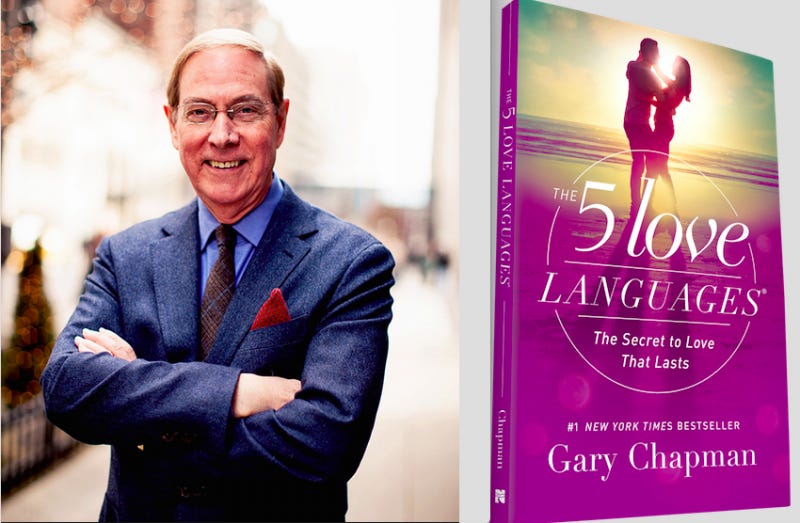
There was no rigorous data collection and analysis. No identifying biases. No ethical review or contextualization. There was no Brené Brown behind the concept.
Not surprised that a religious cishet man decided that he was on to something, wrote a book about it, and we all called it relationship gospel. Gross.
I’m a divorced mom who left an abusive marriage and then came out as a late-in-life lesbian. So my part-time job is analyzing things I took for granted. Now that I’m looking at these Five Love Languages from an off-center point of view, all I see is fawn.
Words of AffirmationFAWNQuality TimeFAWNReceiving GiftsFAWNActs of ServiceFAWNPhysical TouchFAWN
Let me explain:
I’ve spent the past six years thinking about abuse—trying to understand it, how I found myself in the middle of it, and how it has touched nearly every aspect of my personhood. One of the biggest ah-ha discoveries for me has been learning about our survival responses to threat. “Fight or flight” is pretty widely known. There is also “fawn,” a less talked-about trauma response that is exactly what it sounds like: fawning over the abuser or aggressor to defuse, de-escalate, or appease. (Google tells me there are others, like freeze, flop, and faint.)
It can manifest as
Agreeing to something you don’t want to do
Having loose or undefined boundaries
Showering someone with affection, compliments, or assistance
People-pleasing
Over-extending yourself, going above and beyond to serve others
Fawn is a big one for me. And I learned it really early. Like, in-childhood early. Because not only is fawn a tool for de-escalating anger or danger, it’s also a way to get what you want. I learned:
You catch more flies with honey…
Beauty will get you in the door…
Kill them with kindness…
Et cetera. It’s part of classic good-girl training.
Then I grew up and married an explosive man. Uh-oh, he’s upset. I will… [fill in the blank with whatever love language feels appropriate for the situation].
Now, I’m imagining Dr. Chapman sitting in a cushy office, counseling cishet married couples and offering his shiny new Love Languages as a solution to their troubles. Once wives understand their spouse’s preferred method of love and devotion, they can offer it up on a platter, like a good tradwife*.
Do I think all of these couples experienced domestic violence? Not necessarily. What I’m saying is that many religions (and Christianity in particular) frame marriage as a patriarchal structure. There are prescribed roles for each gender. And when there is conflict, couples are often counseled to return to these roles. This is the slippery slope the Manosphere** depends on: ideas that are normalized just enough to keep people nodding along. It’s very subtle programming. And we are still fighting against it. (Obvi.)
In her podcast WCDHT, Glennon Doyle has shared that the couples counselor she and her ex-husband saw (pre-divorce) recommended that Glennon give her cheating husband blow jobs to help improve their relationship. I would love to know what Dr. Chapman thinks: Do blow jobs fall under physical touch, acts of service, quality time, or gift? Perhaps all four? And if you tell him it’s sooo big right before the act of service, well, you can check “words of affirmation” off, too! Win-win!
You might be thinking, “But Jazmine, don’t the Love Language go both ways?”
Sure. But who were they really written for? Not for me. They were written with men and their desires in mind. Then, after the fact, declared to be for women, too.
So, I wrote my own (with the help of my partner, James!) for friends and lovers alike. (Of course, I did!)
1. Listening
I mean, this should be a no-brainer. But it is really shocking how bad some people are at listening, really listening. You know, like not just waiting to speak, but hanging on your words. I think this is what people mean when they talk about being present.
2. Showing up
Now that I’m nearly in my 50s, I’ve witnessed a lot of heartbreak in my friendships. Death, breakups, pregnancy losses, unexpected diagnoses. There is no one-size-fits-all way to show up. So, the best I’ve done is anticipate what a friend needs and then do it, offer it, be it.
My friends have shown up for me by sitting with me in the darkest places. This is what I need. They don’t have to have all the answers or even anything wise to share. I just need them to show up and sit with me, see me, acknowledge that this is hard, and remind me that I’m not alone.
3. Getting invested in my past
I will tell you stories. I will tell you stooooorrries. You don’t need to remember all of them. I just need you to care that all of them are pieces that make up the whole of me—Chapters of the very long, much bigger story I’m living. Ask follow-up questions. Be curious. Because I’m curious about you, too. And this isn’t just for close friends and lovers. It’s for strangers, too. Everyone has a story. And they all make life so dang interesting.
4. Remembering
This one always dazzles me. I have a friend who always remembers what was going on when we last talked, what surgery my mom is about to have, what trip I just came back from, and which kid just had a birthday. She remembers. And then she checks in and asks me about it. Swoon.
5. A ride to (or from) the airport
Friends don’t let friends take a ride share to or from the airport. It is SO expensive and hard to navigate, especially for older or differently abled folks. You gotta read the signs, then lug your suitcases across 3 highways to get to the check-in desk. Bananas. Every time I fly to O’Hare to visit my parents, they meet me at baggage claim. The kids run to their arms, and everyone is shiny happy, no matter how hard the flight. This is relationship gold.
(There is a reason we love the opening scene of Love Actually so much, despite the problematic storylines! Look at all those people who love each other enough to brave airport parking! Priceless.)
6. Take an interest in others’ activities.
I’m a writer-poet. My partner is a woodworker. In addition to the obvious, we have hobbies, pastimes, and things we just love doing. We show up enthusiastically for each other at both poetry readings and softball games, always cheering the loudest.
This goes for friends, as well. A friend of mine joined a dance troupe. After months of classes and rehearsals, they performed as the halftime show at an LA Sparks game. You bet I was there! And I brought a small posse with me.
This is all very new and somewhat half-baked. So, I’d love to know what you would add. What are your Love Languages? Do the old ones still resonate with you? (That’s totally fair!)
I’m so curious! (And that means I love you. 😉)
*Tradwife: “The Rise and Fall of the Trad Wife,” The New Yorker
**Manosphere: “Why ‘manosphere’ content is appealing to some young men,” PBS
In Denmark, where we lived for 10 years, it was a tradition to bring small Danish flags to the airport and wave them maniacally when your loved one came out of the baggage hall. I cried almost every time I saw that. (And when we eventually left Copenhagen, our friends waved us off with flags and I lost my shit). Airport love is real.
What a great piece!! I continually felt stymied by the Love Language thing. Yours makes a ton of sense. Listening! Remembering! Showing Up!. & more. I kept thinking that I must be super strange that one way I feel loved is if my partner gives me space. Somehow giving and getting space seems to be considered a weird, avoidant thing. To me, devotion, being there, really listening, paying attention, communicationg and allowing for SPACE is what love feels like. Am I odd? Well, I know I am, but I mean - is it that odd?